Sunday, May 10, 2020

Sorting and Top N Analysis in Tableau

Sorting in Tableau - 

Lets Understand sorting in Tableau by Creating a simple Example -

1. I have already extracted data of few customer, Now the first step is go to your  worksheet and Choose a Field like I choose Customer Name from dimension and drop in Column Shelve
2. Add Sum(Sales) in Row Shelve.
3. Click on Customer Name (Drop down)in Column Shelve and Choose Sort
Sorting in Tableau Step 1


4. Now in Sort Popup Window Choose the Sort by option, like Data Source order, Alphabetic, Field, Manual or Nested. I want my Visualization sorted based on Sum(Sales), so I choose Field Option.
5. Now Choose type of sort you want like Ascending or Descending radio button as per your requirement.
6. Now Choose Field Name and the aggregate Function, like I want sorting based on Sum of sales amount so Choose Sales in Field Name and Sum in Aggregation.

Sorting in Tableau Step 2
You can also do sorting by Clicking on sort button available near the Axis Caption Name (See small little video available below)
Sorting in Tableau Step 3


Top N Analysis - 

Suppose we have to perform Analysis based on top 10 cities based on Profit. so here are few steps to do that - 
We need to create a report of top 10 Cities based on Profit and we also want to showcase Sales of those cities in Graph

1. Create a Set of Top 10 Cities based on Profit see in Below images  - 
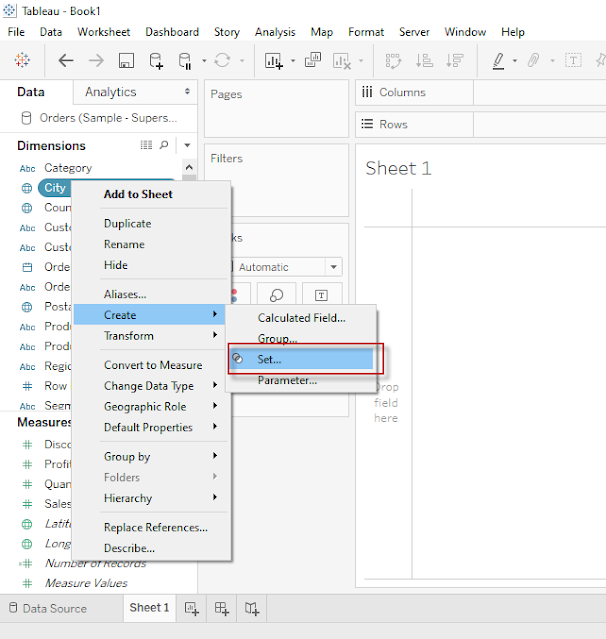
Top N Analysis step 1


2. Give any Name for your newly created Set, and select Top 10 in By Field Section from Create Set pop - 

Top N Analysis step 2

3. Add Newly created Field from sets to Column Shelve and add Sales and Profit in Row Shelve 

4. Click on Drop down for Sum(Profit) as shown in below image and Choose Dual Axis to create a Dual Axis Chart
  
Top N Analysis step 3

5. See Below Analysis created by above step, it has Sales and Profit for top 10 Cities(Who has highest profit)

Top N Analysis step 4

Labels: , , ,

Saturday, May 9, 2020

Different Type of Filters in Tableau

Filters are generally used to restrict the number of records available in data source. In other words Filters are use to create subset of Data. In Tableau there are Filters available at various level for different purposes. 

Given below are the Filter types available in Tableau

  • Extract Filters
  • Data Source Filters
  • Context Filters
  • Dimensions Filters
  • Measure Filters


Extract Filters :

When we use extract data instead of Live data from data source then we can apply filters at Extract level. 

We already know how to Make a connection to data source and what is the difference between live and Extract data in Tableau. Now we are going to learn Extract filters through simple steps, see below images and description - 

Click here to Read more »

Labels: , , ,

Thursday, May 7, 2020

Learn Creating Sets in Tableau

What is Set

Set is a well defined collection of Values.

In Tableau, Set is a Custom Field which we can create to hold some or all Values of a Column based on a Particular Condition.

We Can create Set out of Variable by following methods
  • Selecting data from List
  • Based on a condition (It includes Condition based on another Field or it could be a Range of Values, or we can also create Formula for that)
  • By Selecting Top/Bottom Number of values.
We can create set of Dimensions only, but condition can be based on Measures as well.

For Example-  We want to select/Create a set of those Cities who has sales (Measure) more than 50Lac or we want to create set of Top 10 Cities based on Profit.

How to create Set in Tableau - 

Click here to Read more »

Labels: , , ,

Sunday, May 3, 2020

Types of Chart available in Show Me Pane - Tableau

Tableau is a very advance Data Analysis and Visualization tool, It makes the data analysis very easy through so many techniques without writing any code. One of the very advance feature of Tableau is "Show Me". In "Show Me" we can choose and apply required view on existing data in worksheet.

Those view can be any like Pie Chart, Heat Map, Globe Map, Horizontal/stacked/Side-by-side Bars, Tree Map, Circle View, Area Chart, Gant Chart and many more.

Click here to Read more »

Labels: , , ,

Creating First Visualization in Tableau

Hello Folks - Now we are able to understand basic Concepts of Tableau i.e. What is Tableau and how to start working on this. we know the Component of Tableau Desktop, Now its time to Learn how to create Visualization in Tableau Desktop, also i am going to show how to publish your work on Tableau Public.

When we install Tableau Desktop, it also provide Sample Data of a Superstore for learning purpose, we are going to use that data for this tutorial.

Click here to learn How to connect to a Data source in Tableau then proceed further for Visualization.

After connecting to Sample Data and open Orders in Data Pane, Click on Extract button to Extract
Click here to Read more »

Labels: , , ,

Sunday, April 26, 2020

Dimensions & Measures in Tableau


There are two types of Variables in Tableau - Every variable is categorized in tableau automatically either under dimension or Measures

Let's understand the difference between Dimension and Measure in detail -

Dimensions -

Any Variable with qualitative/Categorical information will be treated as dimension by default in Tableau.
It produce the header when we add this variable to Row Column shelve in Worksheet.

The Actual Definition of dimension is - A dimension is a field that can be considered an independent variable.

To understand it simply any Value Containing any text, date, Geographical location, Boolean value etc are considered as Dimension.

Click here to Read more »

Labels: , , ,

How to Edit Datatype of a Column/Variable in Tableau

Tableau is very smart software, it automatically detect and assign datatype to Variables while making connection with data source.
However, it also provide facility to Change datatype of variable, sometime we need data to be in a particular datatype so here are some stages in which we change datatype of existing variable-

From Datasource Page

First option to change the datatype of a variable is from Datasource Pane, Click on Datatype icon of a variable in data source pane and choose datatype from dropdown list, this is how we can change the datatype from datasource pane. See below screenshot-
datatype from datasource pane

Click here to Read more »

Labels: , , ,

Saturday, April 25, 2020

Types of Variable in Tableau - Datatypes

There are seven primary Datatypes Available in Tableau.

1. String values
2. Number (Integer) values
3. Date values
4. Date & Time values
5. Boolean values
6. Geographic values
7. Cluster or mixed values

When we load our Data or Connect tableau with Data source then Tableau is Smart enough to detect the type of data automatically, Each column/variable is assigned with a different symbol of distinct data type and we can identify the datatype easily.
Tableau also provide the ability to change the datatype from the dropdown in Datapane as shown Below - 
Click here to Read more »

Labels: , , ,

Sunday, April 19, 2020

Difference Between Live Connection and Extract Data

Live: 

  • This allows real time data for analysis from available data source. 
  • It is also known as real time Extract A live connection is a query that underlying data in the data source/database. 
  • When we refresh the visualisation that gives the latest results. 
  • Data is not copied to Tableau Server for preprocessing.
Click here to Read more »

Labels: , , ,

Connect to a Data Source in Tableau


Here we will see how to connect with a Data source Like MS Excel:

When we install Tableau Desktop it provides a Sample Data of a Superstore by default to practice and Learn Tableau:
That is available in your tableau folder on following location:
C:\Program Files\Tableau\Tableau 2020.1\defaults\Datasources\Sample - Superstore.xlsx

We will practice all the exercise and Learn through this data in this and upcoming posts:

Lets follow the below points to connect to the data source to the Tableau
Click here to Read more »

Labels: , , ,